In
Children learn how to fast around age 7, bribed by treats such as trips to McDonalds or toys. Often children are only expected to fast for part of the day, until
People here don't know much about modern medicine, and don’t have access to adequate medical care. Today I witnessed a very disturbing scene: a girl age 13 got in a fight at school and was kneed in the chest. Dessy and I stopped by the house where she lived about one hour after the accident. She was on the floor of the common room surrounded by family and villagers. Someone had smeared red color on her bare chest and forehead. She was supported by her mother and sisters, who were massaging her hands and feet. She was breathing quickly in small gasps and every five minutes or so she would go stiff, arch her back, and scream, apparently in lots of pain. The nearest medical facility is about one day travel from Pankalan Jihing, and the nearest medical officer (not a doctor) about 2 hours away. Luckily the girl recovered, but more serious health emergencies usually end in death due to the lack of immediately available medical care.
Western medical knowledge, even among my friends from the city, is limited. My coworkers believe, for example, that tuberculosis is a genetic disease because if a mother has the disease the children may also have tb. They also don’t know what antibiotics are for (what? You can’t treat a virus with antibiotics?), and think that rashes are a result of being cold. All of this is very disturbing to me, and I hope I can send the SIMPUR staff to first-aid school upon return to
We are now in a village called Pangkalan Jihing. Like Nek Doyan, this place is also dominated by logging, and the logging income has made many people here rich. Even though the village is fairly remote many of the houses here are ornate and new. WE are staying with the kepala dusun (head of subvillage) who is a very stern man and suspicious of our activities. This man is a logging boss, and it shows – his house is huge and beautiful, and includes an indoor shower and toilet – whoohoo!
Today one of my team members came down with chicken pox. Funny: I was expecting to encounter all sorts of strange diseases here in the Asian tropics but all I've seen are chicken pox, head colds, and of course the unavoidable diarrhea. This incident, plus some smaller health problems in the team (impacted wisdom teeth, bee stings, rashes) make me eager to enroll in further first aid training when I get back to the
Unlike the previous villages we’ve visited, Nek Doyan is dominated by Christian/Dayak people, not by Muslim/Melayu people. The difference is immediately obvious when you look at the animal population. In Melayu villages, there are very few dogs, and no pigs, but plenty of cats. In Dayak villages, there are lots of dogs and pigs, but fewer cats. My Muslim coworkers (like most Muslims) strongly dislike dogs and pigs, and are actually afraid to be within a 10-food radius of a dog. I think it is difficult for my friends to live in a Dayak village because of the dog issue. I, on the other hand, prefer the Dayak villages because there are fewer rules – Non-Muslims are allowed to drink alcohol, non-Muslim women can wear any clothing they’d like, and Dayaks seem to have a more flexible perspective of the world (at least this is my analysis).
Today I got stung by a bee. Ouch! This was bound to happen sooner or later – working in the forest we run into all sorts of dangers, from rotting bridges to snakes to bees. Nevertheless, I believe the forest is safer than riding a motorbike in this country.
Nek Doyan is a logging-dominated village. Most men here earn a living by logging, and the only other major village income source is durian. Durian season comes one month per year (December), which makes logging the main activity for the majority of the year. Our host in Nek Doyan is a Muslim hunter, and his wife. Their house is dank and dark, and compared to the other places we’ve stayed not the nicest atmosphere. But the people are nice and the food is good, so I can’t complain too loudly. A medium-sized river runs behind the house, thus only a few steps to the place to bathe and wash clothes.
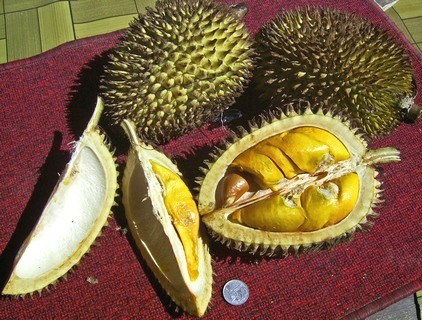
In the field today my teammate and I visited many, many, durian gardens. In case you don’t know, durian is a tropical fruit that is very expensive and smells like poo. Some people love the taste of durian, and others hate it. Durian trees in the region where I am working can be huge, more than 50 meters tall and over 100 cm DBH. These large trees were planted by the ancestors of the people who now live in the village, and were handed down from father to son (or daughter) so that the same family has harvested durian from the same trees for decades. The trees can be very close to the housing area, or as much as a two-hour walk away. I’m very sad I can’t be in the region during durian season (I’m in the “love durian” camp) but perhaps next year…
This time I traveled alone – I had to finish a report for the Indonesian Science Agency to fulfill my visa requirements, so stayed behind in Ponti for a day while the rest of the team continued on to our next study site, a village called Nek Doyan. After finishing the report, I flew to Ketapang and then rode on the back of a motorbike (with my laptop and two backpacks) four hours to our study site. Exhausting, yet exhilarating as well to get around via motorbike. I hope to learn to drive one someday soon…
Haircut. Yes, I did it: my hair is now about an inch long. The decision came after my hair was snagged in rattan for the nth time. Now fieldwork will be much easier, my hair will be easier to care for, but I do miss the long blond curls…
The haircut itself was quite an experience. I walked into the salon on a Sunday evening, and tried to explain that I wanted my hair short. The hairdresser seemed to understand. First he washed my hair, and then unsuccessfully tried to brush it. Eventually I got fed up with the ineffective tugging with a comb, and offered to brush my own hair to speed up the process. After the brushing, my hairdresser started cutting. But he was not brave – each time he would cut off about 2 inches all the way around, and I would instruct him to cut more. This happened about 4 times until he finally got the idea that I wanted really, really short hair and he exclaimed, “Like a boy!” Umm, yeah, like a boy. After an hour-long haircut process, I walked out of the salon with a decent haircut which only cost $2, such a great deal!
Today was our second day with the National Geographic photographers. The plan was to drive to a village called
Illegal logging is a very sensitive issue here in Ketapang District, and our guides were reluctant to take us to the chainsaw noise. They finally agreed after talking with us for a while; I think the three tall blonde tourist-like buleh probably looked so ridiculous we were not threatening.
After walking for about an hour, we found the "orang kerja kayu" (man working wood) in the middle of a burned area, cutting a small partly burnt fallen tree for firewood. So sad! But the photographers took some photos anyway, before hiking back to the road.
We packed into the car again (after taking a few photos of us with the villagers) and started the long drive home, tired and slightly defeated. But as we were driving along the road, we noticed a small river with many people standing nearby, and....timber! A red flag for logging. We hopped out of the car and discovered a very interesting phenomenon: transportation of belian (a high-value timber, so dense it will not float) via rafts, from forest to trucks waiting along the road. Loggers cut the timber into 2-by-4s and nail the 2-by-4s to poles to make a raft that will float. Then the loggers string the rafts together with twine or vines and guide them down the river, two guides per raft.
We stayed at this "port" for a couple of hours. The photographers took many photos while Dessy and I chatted with the workers. Some of the workers are extremely young - maybe 10 years old, already learning to be loggers. Sad, because logging is very tough work.
As it started to get dark outside, we hopped in the car and headed back to home sweet hotel in Ketapang. Upon arrival at the hotel (after a long trip that included a flat tire) we unexpectedly met with the minister of forestry in
Spent the weekend in